Utilisation de la fonction « Coller comme référence » pour créer des liens entre des fichiers dans SOLIDWORKS PDM

Video by Sarah Taylor updated September 26, 2025

Cette vidéo vous plaît ? Obtenir une formation en ligne en direct de Javelin
Suivez un cours de formation en ligne en direct avec un instructeur certifié et devenez un expert SOLIDWORKS.
À propos de la vidéo
Everyone knows that SOLIDWORKS files are interconnected and fully associative by default. Drawings, Assemblies, and Part files reference one another so that design changes automatically update without having to manually track the modifications through a long list of files.
However, outside of SOLIDWORKS, sometimes manual connections need to be made to non-CAD files. This could be to attach a purchase order to an assembly or to link a change order document to the project files to keep everyone in sync. Traditionally, SOLIDWORKS CAD has had the Design Binder that worked for users inside of SOLIDWORKS, but was not much help for those who needed to consume the data downstream. In PDM, file references are tracked and easily available to anyone who has access to the vault. Keep reading to learn more about creating manual references in SOLIDWORKS PDM.
How Does SOLIDWORKS PDM Help?
SOLIDWORKS PDM has what I like to call a “digital paper clip” by way of its Paste as reference command. Pasting a file or set of files as a reference will attach them together and show links in the Contains and Where Used tabs within SOLIDWORKS PDM. You no longer have to manually track affected files, as the data management tools will maintain these external file references to whichever vaulted files you require.
How to Manually Add a File Reference in SOLIDWORKS PDM
Whenever you need to manually link a non-CAD document to another file in your vault, you can follow these steps:
- Establish a file where you want the reference to be added, and which file is the reference. You can think of this like a parent/child file hierarchy similar to SOLIDWORKS parts and assemblies.
- Check out the target document where you want the reference file to be added. When adding references, you do not need to check out the reference file.
- Copy the reference file by right-clicking on it and using the flyout menu.
- On the target document, right-click and Paste as reference.

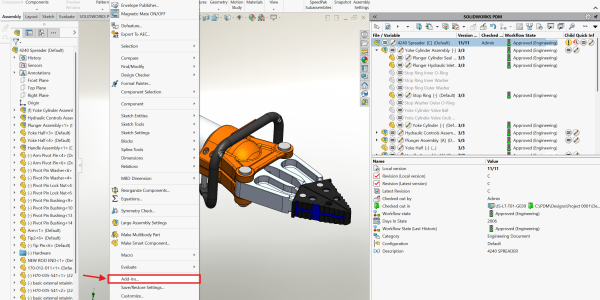
 SOLIDWORKS PDM Paste as Reference Command
 - On the Create File References pop-up window, the “Add Reference” box must be checked. The “Show in Bill of Materials” box is optional, and indicates that this document will be visible in the Bill of Materials tab. Cliquez sur OK.
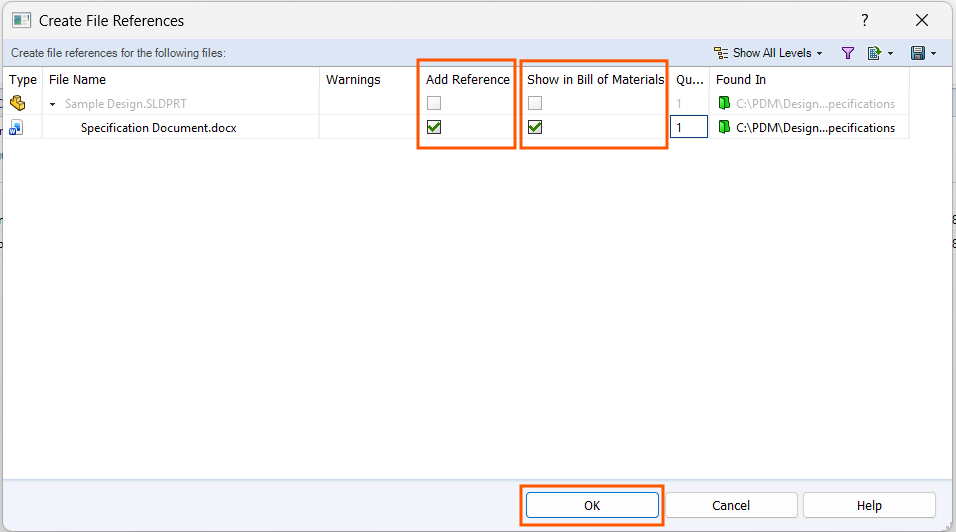 Create File References Dialog
 - Check in the target document.
After following the steps above, the reference will be added and the changes will be synced to the central database.
Where Do the Pasted References Go?
On the target document where the reference was added, you’ll find the reference listed in the Contains tab in the Windows File Explorer interface. In the example below, the specification document was added as a reference to the sample SOLIDWORKS part file.

The specification document is shown in the Contains tab of SOLIDWORKS PDM
This will also be the same if looking from the other direction. Navigating to the reference file, you will find the document it was attached to, as indicated in the Where Used tab.
Additionally, if the “Show in Bill of Materials” box was checked in the Create References dialog, the references will also be visible in the Bill of Materials tab in the File Explorer interface.
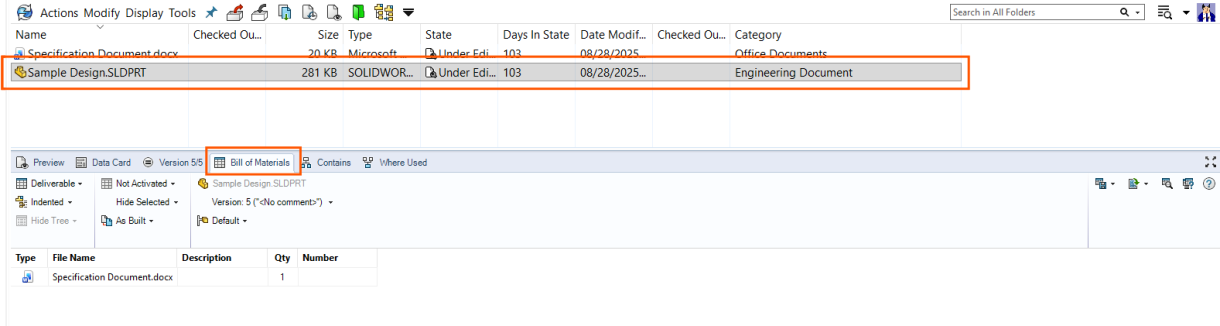
References displayed in the Bill of Materials tab
Extending Beyond Paste as Reference Functionality
While the Paste as reference command is incredibly useful for SOLIDWORKS PDM users to link together files that don’t conform to the standard part, assembly, and drawing architecture, it does have its shortcomings. For example, this requires manually attaching references from the start, and they are treated as if they were any other file within SOLIDWORKS PDM.
SOLIDWORKS Manage can improve upon SOLIDWORKS PDM by providing additional tools for tracking non-CAD files and ensuring the entire team stays on track with projects. With additional flexibility for purchased components, specification sheets, and detailed reporting, SOLIDWORKS Manage could be the next step for your organization to take control of your data.
Content related to 'Using Paste as Reference to Create Links Between Files in SOLIDWORKS PDM'