


Radiation Heat Transfer in the HVAC Module of SOLIDWORKS Flow Simulation

Article by Suman Sudhakaran updated October 7, 2024
Article
Radiation is one of the three primary modes of heat transfer, alongside conduction and convection. Unlike conduction and convection, which require a medium (solid, liquid, or gas) to transfer heat, radiation can occur through a vacuum.
Radiation heat transfer is a critical aspect of thermal analysis in HVAC systems. In SOLIDWORKS Flow Simulation, the HVAC module provides advanced capabilities to simulate radiative heat transfer, enhancing the accuracy and reliability of thermal simulations.
SOLIDWORKS Flow Simulation offers two primary models for simulating radiation heat transfer:
- Discrete Transfer Method
- Discrete Ordinates Method (only available with HVAC module)
The Discrete Ordinates Method is exclusive to the HVAC module and provides enhanced capabilities for simulating complex radiative heat transfer. As stated in SOLIDWORKS Flow Simulation technical reference, the Discrete Ordinates model is a way to approximately solve the radiative transfer equation (RTE) by discretizing both the XYZ-domain and the angular variables that specify the direction of radiation [1]. In this method, the radiative transfer equation (RTE) is solved for a set of discrete directions s representing the directional domain of 4π at any position within the computational domain defined by the position vector r.
The directional domain is broken down into a specified number of equal solid angles or directions. The total number of directions is defined by the user-specified value of the Discretization level. Within each direction, the radiation intensity is considered constant.
The Discrete Ordinates model
Based on the following assumptions [1]:
- The whole 4π directional domain at any location within the computational domain is discretized into the specified number of equal solid angles.
- Radiation-absorptive (semi-transparent) solids absorb and emit heat radiation in accordance with the specified solid material absorption coefficient. Scattering is not considered.
- Surfaces of opaque solids absorb the incident heat radiation in accordance with their specified emissivity coefficients, the rest incident radiation is reflected specularly or diffusively, or via both ways, in accordance with the specified specularity coefficient.
- Radiation absorptive solids reflect radiation specularly, the radiation is refracted in accordance with the specified refraction indices of the solid and adjacent medium. The refraction index value cannot exceed 4.
The spectrum can be specified for radiation from the computational domain boundaries and for radiation sources set on surfaces of opaque solids. A multiband (Discrete Bands) approach is used to model spectral dependencies in radiative heat transfer.
At the surfaces of opaque solids, incident heat radiation is absorbed depending on the specified emissivity coefficient, and the rest of the incident radiation is reflected. The opaque surfaces can also emit heat radiation diffusively in accordance with the surface temperature and the specified emissivity coefficient. Since all fluids are considered as transparent to heat radiation, the heat radiation propagates through them, as well as through transparent solids, without any interaction with them. However, as the heat radiation is traced through the computational domain by the discrete ordinates method, the “false scattering” effect caused by the discretization inaccuracies can appear. Creating a finer computational mesh along with a higher discretization level allows for the reduction of this effect.
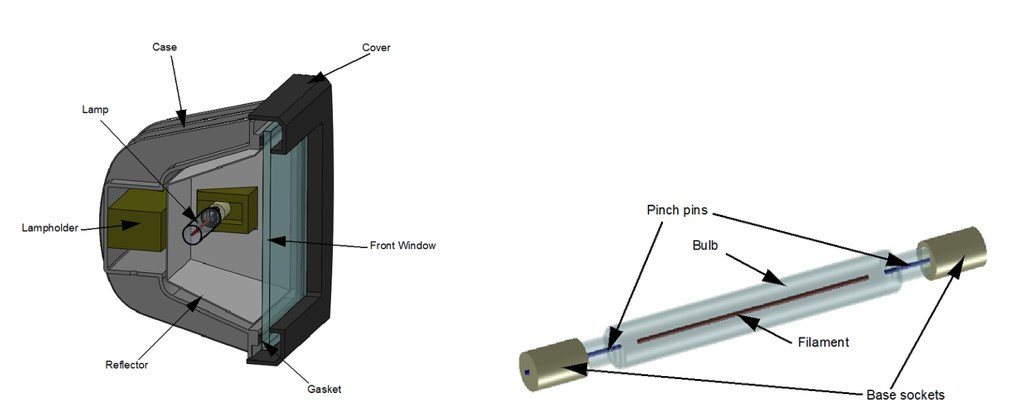
The example below shows heat transfer by conduction and radiation, including the radiation absorption in semi-transparent solids and the radiation spectrum for a halogen floodlight operating in indoor conditions without any forced cooling. The model consists of a halogen floodlight with aluminum housing that houses a quartz glass front window, a silicone gasket, an aluminum internal reflector, a ceramic lamp holder, and a 150 W linear halogen lamp.
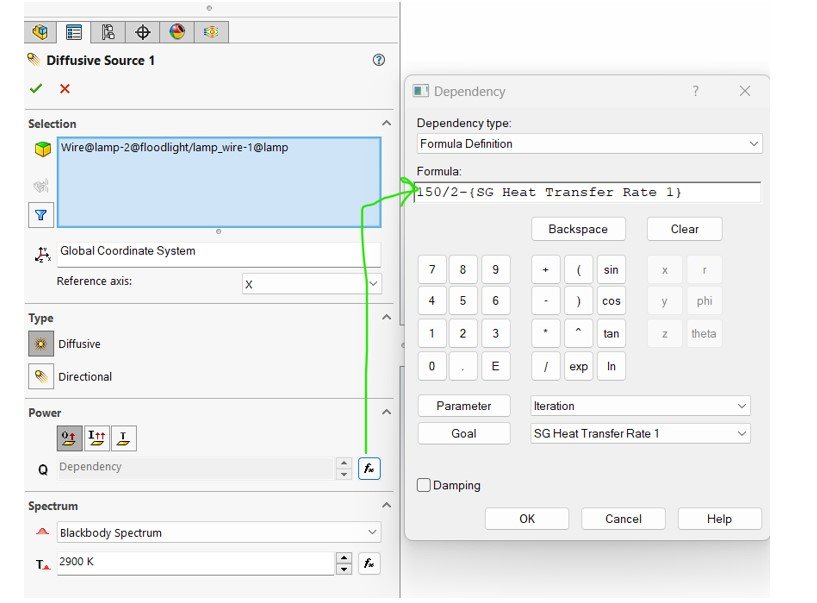
The radiation source was defined for the bulb lamp filament and the diffusive power was defined to be dependent on the convective heat transfer rate of the filament.
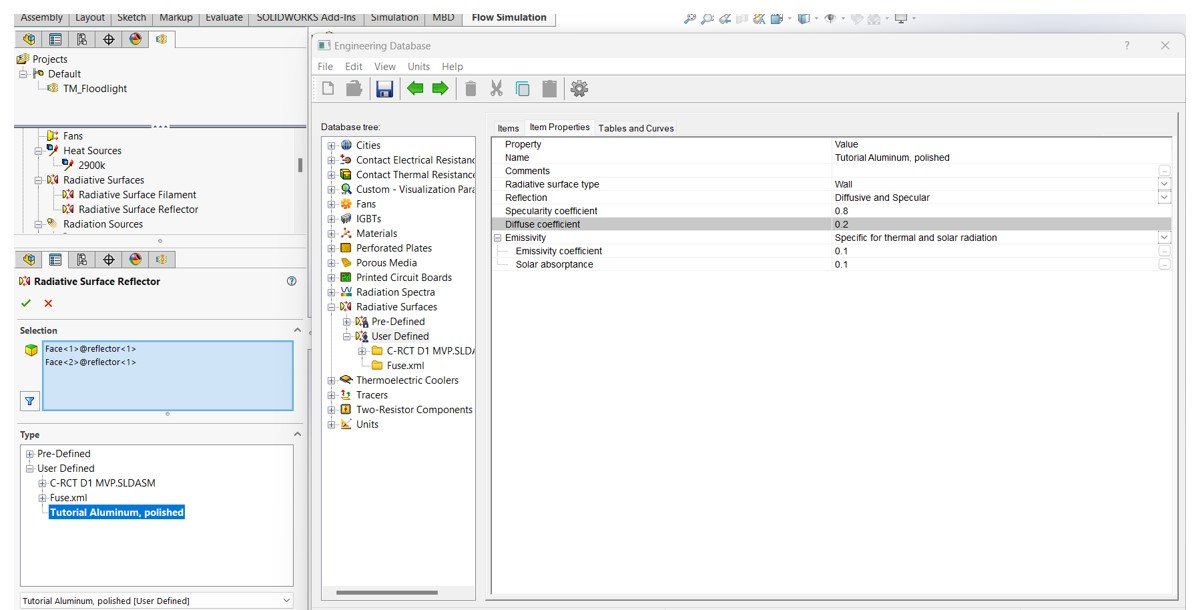
Radiative surfaces were specified using user-defined material properties and pre-defined Whitebody wall material in SOLIDWORKS Flow Simulation’s engineering database.
Materials for Bulb and Glass were set to be semi-transparent using the “absorptive” option. This setting enables these two solid bodies to absorb heat radiation within their volume.

To improve the accuracy of the simulation when using the Discrete Ordinate method, a higher level of discretization can be specified in the Calculation control option.
The image below shows the surface plot of glass temperature distribution and the cut plot of the total temperature distribution of both fluid and solids.

Accurate thermal analysis is crucial for designing efficient and effective heating, ventilation, and air conditioning solutions. The HVAC module’s advanced radiation capabilities enable engineers to:
- Assess the impact of solar heat gain on building interiors and HVAC loads.
- Analyze heat transfer between surfaces, including walls, floors, and ceilings, to optimize thermal comfort and energy efficiency.
- Model Semi-Transparent Materials to accurately simulate the behavior of materials like glass which can absorb and transmit radiation.
By utilizing the advanced features of the Discrete Ordinates Method, users can achieve higher fidelity in their simulations, leading to better design-informed product innovations.
Related Links
Certified SOLIDWORKS Services available from Javelin
Javelin can help you to:
Posts related to 'Radiation Heat Transfer in the HVAC Module of SOLIDWORKS Flow Simulation'
